AI has become one of the biggest conversations in every product company.
Founders want it in their products. Customers expect it. Competitors are launching AI features every few months.
So the natural question becomes:
“Where can we add AI?”
I think that's the wrong question.
The better question is:
“What problem in our business would become significantly better if we used AI?”
That small change in thinking can completely change the outcome.
Adding an AI assistant to your product may look impressive.
Adding an AI chatbot to your website may generate attention.
Automating something with an LLM may make a great demo.
But none of these automatically create business value.
The real value comes when AI improves something that already matters to the business, such as revenue, customer experience, operational efficiency, product adoption, or engineering productivity.
AI should solve a business problem first.
The technology comes second.
Before deciding what AI capability to build, ask what is currently slowing the business down.
Are customers spending too much time finding information?
Are employees spending hours doing repetitive work?
Are support teams answering the same questions every day?
Are sales teams struggling to understand customer intent?
Are product teams spending too much time processing and analyzing information?
These questions lead to much better AI opportunities than simply asking where an AI feature could fit.
This is something product teams often overlook.
Just because something can be done with AI doesn't mean it should be built.
An AI feature that customers rarely use won't create meaningful value.
An automation that saves five minutes a week isn't going to transform the business.
And an expensive AI system that creates more operational complexity than value can become another problem for the team.
The goal isn't to add more AI.
The goal is to create more value with AI.
One of the easiest ways to identify valuable AI opportunities is to look at repetitive work.
Where are employees copying information between systems?
Where are teams manually reviewing documents?
Where are customers waiting for answers?
Where are people making decisions based on information scattered across multiple places?
These are often better starting points than brainstorming another AI feature.
The best opportunities are usually hiding inside everyday work.
AI doesn't always mean building an entirely new product.
Sometimes the biggest opportunity is already sitting inside something your customers use every day.
A search experience can become intelligent.
A reporting system can become conversational.
A workflow can become automated.
A support platform can understand customer context.
A product can make recommendations instead of simply presenting information.
In many cases, the opportunity isn't to replace the product.
It's to make the product significantly more useful.
There's another question every product leader should ask:
“What becomes easier for our customer because of this?”
If the answer is unclear, the AI initiative probably needs more thought.
Customers don't care that your product uses the latest model.
They care that they can finish a task faster.
They care that they don't have to search through ten screens.
They care that something that used to take an hour now takes five minutes.
The technology should disappear behind the experience.
A successful AI initiative should have something measurable behind it.
Maybe it reduces support workload.
Maybe it improves conversion.
Maybe it increases product adoption.
Maybe it reduces the time required to complete a process.
Maybe it allows your existing team to handle significantly more work.
The exact metric will depend on the business.
But there should be a clear connection between the AI investment and the outcome you're trying to improve.
Once you've identified the right opportunity, then engineering becomes critical.
Can the existing product support it?
What data is available?
How should the AI capability connect with existing workflows?
What needs to be built?
What should be automated?
What should remain under human control?
These are important questions, but they should come after deciding what problem is worth solving.
Otherwise, teams can spend months building something technically impressive that customers never really needed.
Think about the products people love using.
The best experiences don't constantly remind you that AI is running in the background.
They simply help you accomplish something better.
The customer gets a faster answer.
A better recommendation.
A simpler workflow.
A more personalized experience.
That is where AI becomes valuable.
Not when the technology gets attention, but when the outcome does.
AI is no longer something companies can treat as a side experiment forever.
But adopting AI doesn't mean putting an AI feature into every part of your product.
It means understanding where intelligent capabilities can create a meaningful advantage.
That requires product thinking, engineering expertise, customer understanding, and a clear connection to business outcomes.
The companies that get this right will not necessarily be the ones using the most AI.
They'll be the ones using it where it matters most.
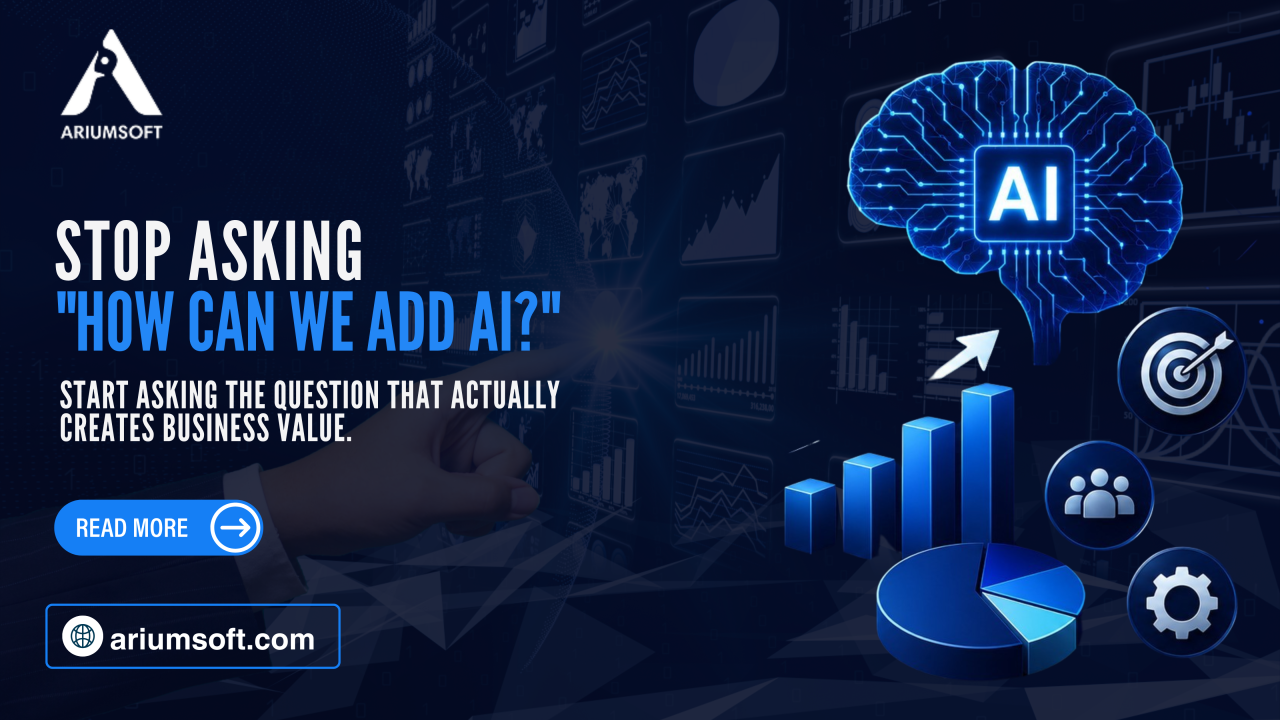
Instead of asking:
“How can we add AI to our product?”
Ask:
“Where can AI create a measurable improvement for our customers or our business?”
That question changes the conversation.
It moves AI from a technology experiment to a business initiative.
And it helps teams focus their time and investment on opportunities that can actually make a difference.
At Ariumsoft, we don't believe every business needs another AI feature.
We help product companies identify practical opportunities for AI, integrate intelligent capabilities into existing platforms, build new digital products, automate workflows, and create the engineering capacity needed to turn those ideas into production.
The objective isn't simply to make a product more intelligent.
It's to make the business faster, more efficient, and more valuable to its customers.
Because the question isn't whether your company should use AI.
The more important question is:
Where can AI actually move your business forward?
That's the question worth answering first.
We are offering a 30-minute call to founders, CTOs, and product leaders who want to find faster ways to build products, use artificial intelligence, improve existing platforms, or increase their engineering capacity without hiring a large team.
Learn more: Ariumsoft AI Engineering Offer
Book your call: Book a 30-minute call
At Ariumsoft, we believe the companies that grow the fastest aren't necessarily the ones with the biggest engineering teams.
They are the ones that can consistently turn ideas into products faster than everyone else.
.avif)