Most organizations believe AI success comes from using the most advanced model available.
In reality, AI success comes from building the right system around the model.
The industry often obsesses over model benchmarks, reasoning scores, and context windows. Yet in production environments, the model itself is only one component of the solution.
The real challenge is orchestration.
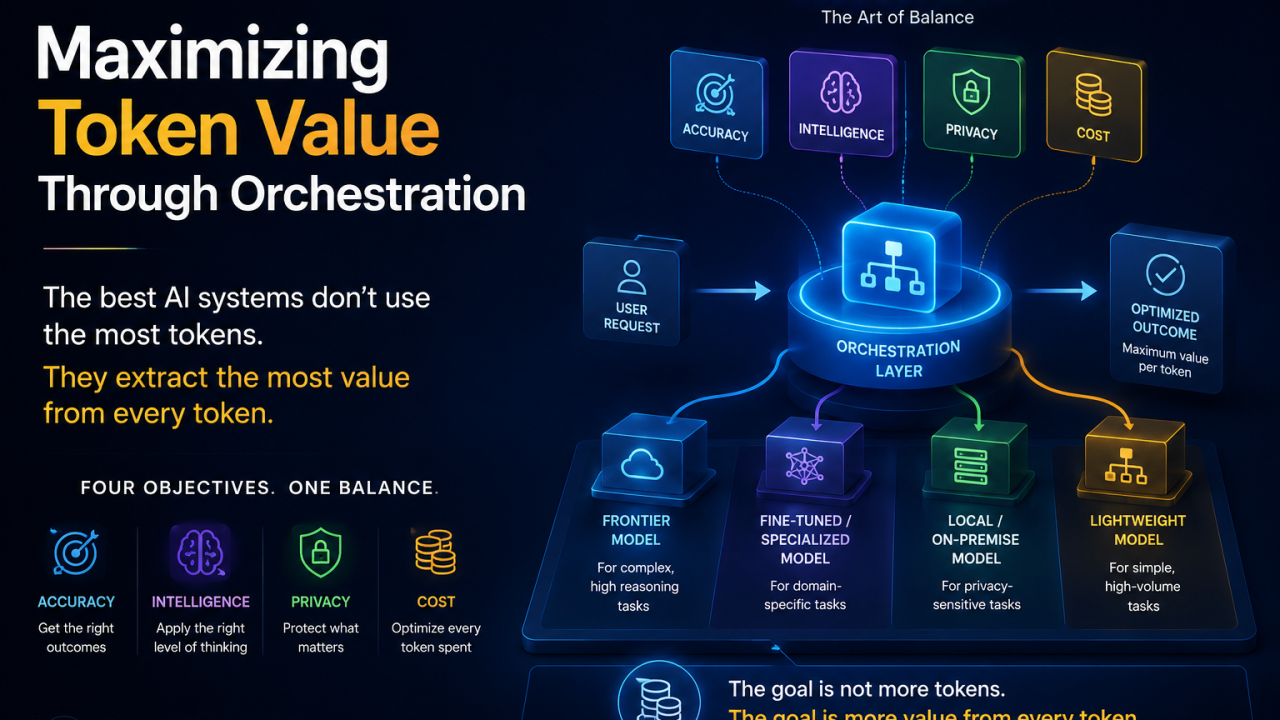
Every AI system operates under four competing objectives:
Many teams optimize heavily for intelligence and accuracy by routing every request through the largest available model. While this can produce impressive results, it often creates unsustainable operating costs, higher latency, increased privacy exposure, and poor scalability.
The goal is not to maximize intelligence.
The goal is to maximize value per token.
This requires orchestration.
An orchestrated AI system determines:
The most successful AI systems are often those that make average models perform exceptionally well.
This is achieved by building the right harness around the model.
For example:
The question should never be:
"Which is the smartest model?"
The better question is:
"What is the minimum intelligence required to achieve the desired business outcome?"
Organizations that answer this question correctly build systems that are:
In many cases, a well-orchestrated system using a smaller model can outperform a poorly designed system using the most advanced model available.
The future of enterprise AI will not be determined solely by model capability.
It will be determined by architectural discipline.
The winners will not be those who have access to the smartest models.
The winners will be those who know exactly when a smart model is necessary—and when it is not.
At Ariumsoft, we believe AI engineering is the discipline of maximizing business value from every token consumed. The true competitive advantage lies not in model selection, but in orchestration design.
.avif)